At kbs Intelligence, we’re always looking at ways to strengthen fraud detection by combining practical experience with emerging technology.
One recent project involved exploring the use of graph neural networks (GNNs) in staged accident fraud detection. Supported through an Innovate UK-funded R&D project under UK Research and Innovation (UKRI), the work focused on a simple question: could a graph-based approach add value alongside existing fraud detection methods?
Why Connected Data Matters
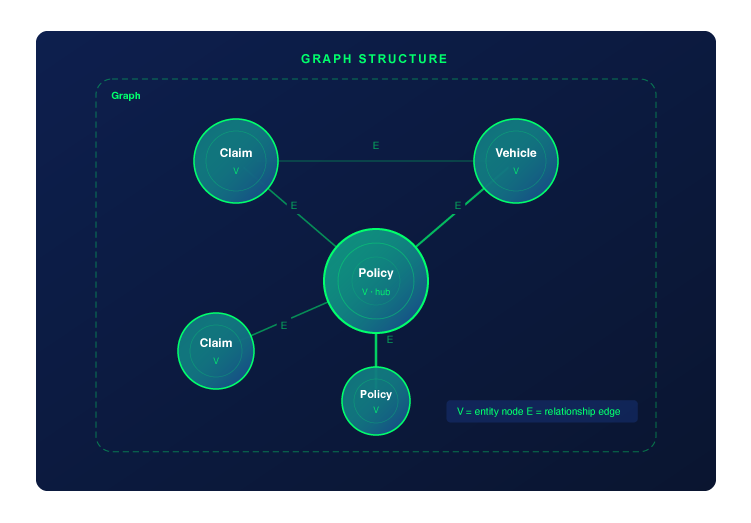
Fraud rarely exists within a single claim alone. More often, the real insight sits in the relationships around it, between claims, vehicles, policies and other connected entities. When those links are brought together, it becomes easier to build a clearer picture of risk, uncover patterns and identify suspicious behaviour that might otherwise be missed.
At kbs Intelligence, connected data already plays an important role in how we approach fraud. This project allowed us to take that further by exploring whether GNNs could add another layer of intelligence to our existing fraud detection capability.
Why Graph Neural Networks?
Our existing machine learning models are highly effective at identifying suspicious entities and behaviours. What interested us about GNNs was their ability to work directly with graph-structured data, helping them understand not only the characteristics of individual entities but also the relationships between them.
That distinction is important. In many fraud scenarios, the connections between people, vehicles, policies and claims can be just as valuable as the individual records themselves.
Rather than looking at isolated data points, graph neural networks are designed to understand the wider context of a network and the way entities interact within it.
Why Staged Accident Fraud?
For this proof of concept, we focused on staged motor accident fraud.
It was a natural place to start because staged accidents often involve interconnected claims, vehicles and policies, creating relationship patterns that can be difficult to assess through traditional approaches alone.
The hypothesis was straightforward: if a model could better understand those relationships, it might uncover additional fraud indicators and complement our existing staged accident detection capability.
What We Found
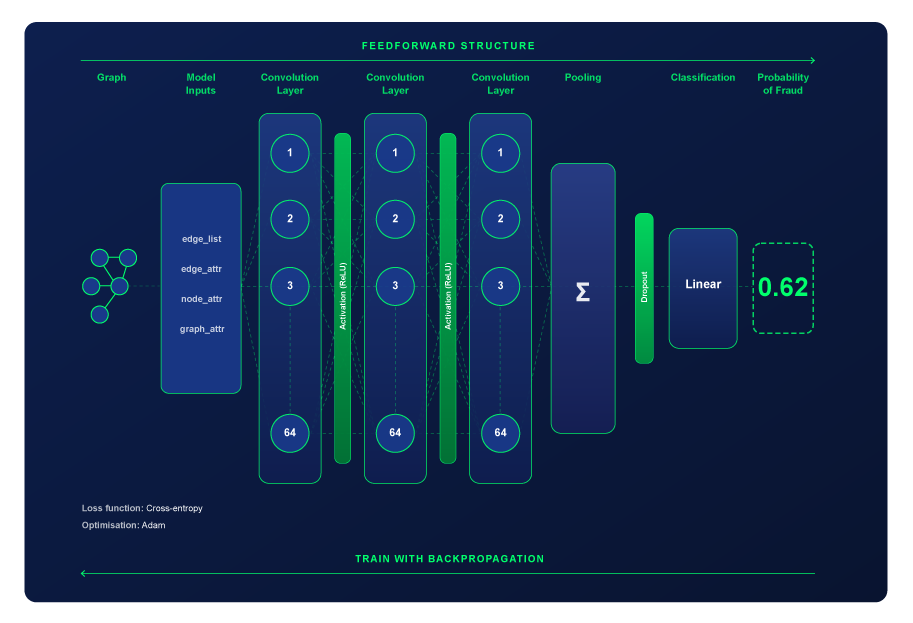
To test the approach, we created training and testing datasets from 1,003 graphs within our Amazon Neptune graph database. These graphs represented motor insurance claims, vehicles, and policies, with 252 containing positive staged accident outcomes.
The model was trained to learn both the characteristics of the entities involved and the relationships between them. The results were encouraging. The GNN achieved an AUC score of 0.82, a strong result for a proof-of-concept model. More importantly, 38% of the positive outcomes identified by the GNN had not been detected by our existing staged accident model.
That finding is particularly significant because the project was never intended to replace existing detection methods. The objective was to explore whether a graph-based approach could add another layer of insight alongside them.
What This Means For Fraud Teams
For fraud teams, the value lies in the potential to complement existing detection methods with additional context and insight. The project reinforces something many investigators already know: valuable fraud indicators often sit within networks of connected entities rather than within individual records alone. By understanding those relationships more effectively, graph-based approaches may help uncover suspicious activity that would otherwise be difficult to identify.
Where This Work Goes Next
The project has provided a strong proof of concept, a clear use case and encouraging early results. Our focus now is on developing the work further and exploring how graph-based approaches can be applied more broadly across fraud detection use cases. While there is still more work to do, the project has demonstrated the potential of graph neural networks to complement existing fraud detection methods and support stronger identification of suspicious claims.
The project has been supported through an Innovate UK-funded R&D programme under UK Research and Innovation (UKRI). The funding enabled us to explore an emerging approach to fraud detection in a real-world insurance context, accelerate development of the proof of concept and assess its potential alongside existing detection methods.